


Application status: Currently closed. Yale says applications for its 2027 cohort closed on July 30, 2026, at 11:00 a.m. Eastern Time. The program itself takes place in 2027, but Yale is no longer accepting applications for this cohort.
- Yale Emerging Leaders Fellowship 2027 Details
- Benefits of Yale Emerging Leaders Fellowship 2027
- Eligibility for Yale Emerging Leaders Fellowship 2027
- Required Documents for Yale Emerging Leaders Fellowship 2027
- Step-by-Step Application Process
- Yale Emerging Leaders Fellowship 2027 Deadline
- Frequently Asked Questions
- Is Yale Emerging Leaders Fellowship 2027 still open?
- Is this fellowship a Yale degree program?
- Does Yale pay for travel?
- Is there an age limit?
- Can fellows participate entirely online?
- How many recommendation letters were needed?
- Apply Now and Official Website
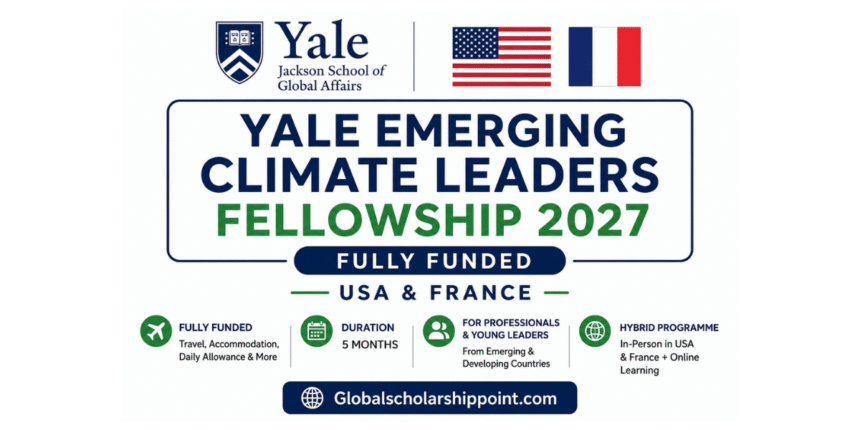
The Yale Emerging Leaders Fellowship 2027 covered in this guide is officially called the Yale Emerging Climate Leaders Fellowship. Run by the International Leadership Center at the Yale Jackson School of Global Affairs, it brings together professionals working on climate change and clean energy in emerging and developing economies.
Over five months, fellows meet at Yale University in the United States, collaborate remotely, and gather again in Paris, France. The program is designed for people who already have experience in their fields and want to learn from others facing different versions of the same climate challenges.
If you found this page while looking for an open opportunity, please note the closed status before reading further. This updated guide explains what the 2027 fellowship offers, who it is for, and how its application worked. You can use those details to assess a future cohort if Yale announces one.
Yale Emerging Leaders Fellowship 2027 Details
| Detail | Information |
|---|---|
| Official name | Yale Emerging Climate Leaders Fellowship |
| Host | Yale Jackson School of Global Affairs, International Leadership Center |
| Cohort | 2027 |
| Program type | Professional climate leadership fellowship |
| Format | In-person weeks in New Haven and Paris, plus remote learning |
| Duration | Approximately five months |
| Number of fellows | About 16 each year |
| Intended participants | Climate and clean energy professionals from emerging and developing economies |
| Application fee | $20 |
| 2027 deadline | July 30, 2026, at 11:00 a.m. Eastern Time |
| Current status | Closed for the 2027 |
| Yale Orientation Week | February 1–5, 2027 |
| Paris Closing Week | June 14–18, 2027 |
This is not a master’s degree or a university admission offer. Fellows take part in a professional development program while continuing to draw on their own work and experience.
Benefits of Yale Emerging Leaders Fellowship 2027
The Yale Emerging Leaders Fellowship 2027 gives fellows time to step back from daily work and examine climate problems with people from other professions and countries. Its schedule combines expert discussions with collaborative work, so the value is both in what fellows learn and in the relationships they build.
Yale covers round-trip airfare, hotels, and transfers for the two in-person weeks. Most meals during those weeks are also provided. Yale says there are no direct program participation costs beyond the application fee.
There are costs worth planning for, however. The $20 application fee was required for the 2027 cycle. Visa fees may be reimbursed, but an individual may have to pay them upfront. Travel to and from visa appointments is the individual’s responsibility. Yale does not describe this fellowship as a salaried job or a scholarship covering a degree.
The program has three connected stages. Fellows begin with an orientation week in New Haven, Connecticut, where they meet Yale faculty and climate practitioners. From March through June, they take part in remote sessions with international experts and work together on a group policy project. The fellowship ends with a week in Paris, where they meet people involved in international climate work and present their recommendations.
The conversations can cover renewable electricity, energy access, climate finance, carbon pricing, methane reduction, nature-based solutions, and communication. Someone who works on one of these issues locally may see it differently after hearing how a fellow in another country approaches it.
For readers interested in renewable energy opportunities, our IRENA Youth Forum 2027 guide describes a separate program with its own eligibility and deadline.
Eligibility for Yale Emerging Leaders Fellowship 2027
Yale looks for working professionals, typically five to fifteen years into their careers. Candidates should have a record of achievement related to climate change or clean energy and show potential to make a wider impact. There is no age requirement.
The fellowship is intended for rising leaders from emerging and developing economies. Yale does not maintain a strict public list of eligible countries. Its guidance says successful applicants should originate from and reside in an emerging or developing country when they apply. Yale seeks a geographically balanced cohort, including people from Africa, Asia, the Middle East, Latin America, and the Caribbean.
Participants need to speak English fluently enough to take part in discussions and group work. They must also be available for every part of the program. The weeks in New Haven and Paris cannot be completed online.
There is no single career path into climate leadership. Yale describes fellows from government, energy companies, finance, research, journalism, education, law, civil society, and other fields. What matters is whether your work connects to climate or clean energy and whether you can explain the contribution you have made.
Yale says applicants with less than five years of experience may still be considered when their work is especially relevant. Substantial full-time internships with real leadership and responsibility can also count. If that applies to you, a clear account of your work will help readers of your application understand its significance.
Here is a useful question to ask yourself: What changed because I was involved? Perhaps you helped a community understand an energy project, improved a policy proposal, or got people with competing priorities to work together. Specific examples are more helpful than saying only that you care about climate action.
Readers comparing opportunities for experienced professionals can also see our Hubert H. Humphrey Fellowship Program 2027 guide. Its purpose and requirements differ from Yale’s, so review each program on its own terms.
Required Documents for Yale Emerging Leaders Fellowship 2027
Yale listed the following materials for the 2027 application:
- Résumé or CV: No more than three pages.
- Personal statement: No more than 600 words.
- Video statement: A 90-second recording made within the application system.
- Recommendation letter: One letter, submitted through Yale’s process.
- Online form and payment: A completed application with a $20 fee.
The limits matter. A short personal statement leaves little room for an autobiography, so choose an example that helps explain your work and your next goal. Describe the problem, what you did, what happened, and what you still need to learn.
For the video, Yale’s guidance says applicants get two recording attempts. If you make a second recording, that final attempt is the one reviewed. Practicing aloud with a timer can help you speak clearly without sounding as though you are reading from a script.
Ask for a recommendation from someone who has seen you handle real work. A manager, collaborator, or professional mentor who can describe a decision you made may be better placed to write a useful letter than someone who knows only your job title. Give that person enough time to prepare it.
The Yale Emerging Leaders Fellowship 2027 application is closed, so these materials are listed for reference. Requirements may change if Yale opens another cohort. Check the official instructions before preparing an application for a future year.
Step-by-Step Application Process
The following steps explain how the Yale Emerging Leaders Fellowship 2027 process worked. They are not instructions to apply now: Yale has closed the 2027 application.
Step 1: Check your fit. Read Yale’s criteria for professional experience, climate-related achievement, country of origin and residence, English fluency, and availability.
Step 2: Review the schedule. Make sure you can attend the in-person weeks and the remote sessions. If you would need time away from work, discuss that commitment early with your organization.
Step 3: Prepare a focused CV. Keep it within three pages. Show the decisions, projects, or results that best demonstrate your contribution to climate or clean energy work.
Step 4: Write the personal statement. Follow the 600-word limit. Connect your experience to the questions you hope to explore with other fellows.
Step 5: Choose one recommender. Ask someone who can give firsthand examples of your judgment, leadership, and ability to work with others.
Step 6: Plan the video response. Practice a concise answer before recording the 90-second statement in Yale’s application system.
Step 7: Review and submit. During an open cycle, check that every required part is complete and pay the application fee before the stated deadline. Yale says submitted applications cannot be edited afterward.
If you are exploring a different leadership exchange, our YSEALI Academic Fellows Program 2027 article covers a program for eligible young leaders in Southeast Asia.
Yale Emerging Leaders Fellowship 2027 Deadline
The 2027 application is currently closed. Its deadline was Thursday, July 30, 2026, at 11:00 a.m. Eastern Time. Yale’s official fellowship page confirms that it is no longer accepting applications for this cohort.
The dates in February and June 2027 are program dates for selected fellows, not new application windows. Yale has not provided a future application deadline on the 2027 page. If another cycle is announced, use its new official instructions rather than assuming the dates or requirements will stay the same.
If you submitted an application before the deadline, Yale provides a portal where you can check its status. Its fellowship page says successful applicants will be contacted by the admissions team.
Frequently Asked Questions
Is Yale Emerging Leaders Fellowship 2027 still open?
No. Applications for Yale’s 2027 Emerging Climate Leaders Fellowship closed on July 30, 2026, at 11:00 a.m. Eastern Time.
Is this fellowship a Yale degree program?
No. It is a five-month professional fellowship with in-person and remote activities. It does not provide admission to a Yale degree.
Does Yale pay for travel?
Yale says it covers round-trip airfare, hotels, and transfers for the two in-person weeks, and provides most meals during those weeks. Applicants for the 2027 cycle had to pay a $20 application fee.
Is there an age limit?
No. Yale states that there is no age requirement. It generally seeks rising professionals with five to fifteen years of career experience.
Can fellows participate entirely online?
No. Attendance at both the in-person and remote components is required. Yale says the in-person weeks cannot be completed online.
How many recommendation letters were needed?
The 2027 application required one recommendation letter. Yale says it accepts only one letter per applicant.
Apply Now and Official Website
The Yale Emerging Leaders Fellowship 2027 brought together a small group of professionals to learn across borders and bring ideas back to their work. If the next cohort interests you, keep a record of the climate projects you have helped shape, including your own role and the outcome. Those details will help you judge your fit when Yale publishes new information.
For another international professional experience to compare, see our OECD Internship Program guide. Check its current eligibility separately; it is an internship, not the Yale fellowship.