


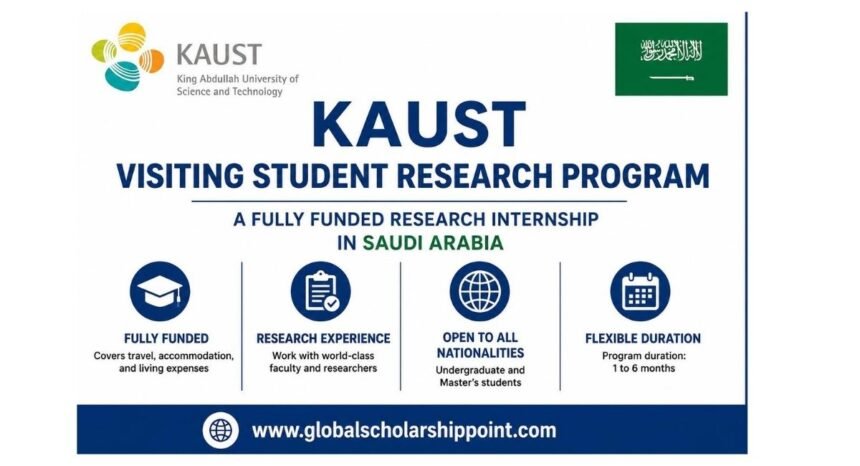
The KAUST VSRP Internship offers international students an excellent opportunity to gain practical research experience at King Abdullah University of Science and Technology in Saudi Arabia. This fully funded program is designed primarily for third- and fourth-year bachelor’s students and current master’s students studying science, technology, engineering, or mathematics.
- KAUST VSRP Internship Overview
- About King Abdullah University of Science and Technology
- Financial Benefits of the KAUST VSRP Internship
- Internship Duration and Starting Dates
- Available Research Fields
- KAUST VSRP Internship Eligibility Criteria
- English-Language Requirements
- Required Application Documents
- How to Select a Suitable Research Project
- KAUST VSRP Internship Selection Process
- Application Deadline
- How to Apply for the KAUST VSRP Internship
- Final Thoughts
Selected interns join a faculty-led research project for two to six months. Participants receive a monthly stipend, private accommodation, return airfare, and access to KAUST’s advanced laboratories and research facilities. Applications are accepted throughout the year, allowing students to select dates that fit their academic schedules.
KAUST VSRP Internship Overview
| Information | Details |
|---|---|
| Program name | KAUST Visiting Student Research Program |
| Short name | KAUST VSRP |
| Host institution | King Abdullah University of Science and Technology |
| Host country | Saudi Arabia |
| Program type | Fully funded research internship |
| Eligible applicants | Bachelor’s and master’s students |
| Academic fields | Science, technology, engineering, and mathematics |
| Internship duration | 2–6 months |
| Monthly stipend | USD 1,000 |
| Application fee | No application fee |
| Application deadline | Open throughout the year |
| Application method | Online |
About King Abdullah University of Science and Technology
King Abdullah University of Science and Technology, commonly known as KAUST, is an international research university located in Thuwal, Saudi Arabia. The university concentrates on graduate education and research in scientific and technological fields.
KAUST brings together students, researchers, and faculty members from more than 100 nationalities. Its research environment supports collaboration across different subjects, including artificial intelligence, engineering, environmental science, bioscience, energy, water, and marine research.
Through the KAUST VSRP Internship, visiting students can work with experienced researchers and use modern equipment within the university’s laboratories and major research facilities. The experience can also help students decide whether they want to pursue graduate studies or a long-term research career.
Financial Benefits of the KAUST VSRP Internship
The program is fully funded, which significantly reduces the financial burden of completing an international internship. According to the official KAUST information, successful applicants receive the following benefits:
- A monthly living allowance of USD 1,000
- A private bedroom and bathroom
- Return airfare to KAUST
- Access to core laboratories and research facilities
- Access to major university and community facilities
- Participation in social and cultural activities
- The opportunity to work directly with KAUST faculty and researchers
Applicants do not need to pay an application fee. However, selected students should carefully read their official offer and internship documents because the final travel and accommodation arrangements are determined by KAUST.
Students interested in other funded research opportunities can also explore the OIST Internship Program in Japan and the WIPO Internship Program.
Internship Duration and Starting Dates
The KAUST VSRP Internship lasts for a minimum of two months and a maximum of six months. An internship cannot normally be completed in less than two months.
Applications are available throughout the year, and students can propose suitable starting and ending dates. The final period depends on the research project, the availability of the supervising faculty member, and approval from the university.
Applicants should select dates when they can participate fully without conflicts with classes, examinations, or other responsibilities at their home institution. Applying early is recommended because the university needs time to evaluate the application and complete travel arrangements.
Available Research Fields
KAUST provides more than 100 faculty-led internship projects covering different STEM subjects. The exact list can change as new projects become available or existing positions are filled.
Research areas may include:
- Artificial intelligence
- Computer science
- Data science
- Applied mathematics
- Statistics
- Electrical engineering
- Mechanical engineering
- Chemical engineering
- Materials science
- Bioscience
- Marine science
- Environmental science
- Earth science
- Energy and renewable technologies
- Water research
- Plant science
- Robotics
- Applied physics
Each project page explains the research objectives, expected outcomes, recommended academic background, and preferred technical skills. Candidates should choose a project closely connected to their education and experience.
KAUST VSRP Internship Eligibility Criteria
Candidates interested in the KAUST VSRP Internship should meet the following general requirements:
- Applicants must be undergraduate students in their third year or above or current master’s students.
- They must be studying a relevant STEM subject.
- A minimum GPA of 3.5 on a 4.0 scale, or its accepted equivalent, is required.
- Applicants must demonstrate sufficient English-language ability.
- They must possess the academic knowledge or practical skills required by their selected project.
- Candidates must be available for an internship lasting between two and six months.
- A valid passport with at least six months of validity is required.
- All application documents must be submitted correctly.
Current PhD students, KAUST students, and KAUST alumni are not eligible for the standard program.
Students who have recently graduated may still qualify if they completed their degree no more than one year before the proposed internship starting date. Individual projects may also have additional eligibility conditions.
English-Language Requirements
Applicants must demonstrate adequate English proficiency because research activities and communication at KAUST are conducted in English.
The official internship page currently lists the following minimum results:
- IELTS: 6.5 overall, with at least 6.0 in every section
- Pearson Test of English Academic: 64 overall, with at least 61 in every section
- Cambridge C1 Advanced or C2 Proficiency: 176 overall, with at least 169 in every section
- Duolingo English Test: 110 overall, with at least 100 in every section
KAUST’s page also displays a TOEFL result of 4.5 overall and 4.0 in each section. Because this score does not follow the common TOEFL iBT scoring scale, applicants relying on TOEFL should confirm the accepted test version and score directly through the official application portal.
An English test score may not be required from applicants who earned a degree through in-person study at an accredited institution in the United States, Canada, the United Kingdom, Ireland, Australia, or New Zealand.
Candidates may submit an application without an English test result. However, successful candidates can later be required to provide an acceptable score. KAUST states that candidates who do not meet the requirement may receive a Duolingo test token.
Required Application Documents
Applicants for the KAUST VSRP Internship should prepare these documents:
- A current curriculum vitae
- A clear statement of purpose
- Official academic transcripts in English for all degrees
- One recommendation letter from a faculty member at the applicant’s current institution
- A valid passport with at least six months remaining
- English-language results when requested
- Any additional documents specified by the selected research project
Applicants nominate their recommender in the application system. KAUST contacts that person directly during the admission process, so candidates should inform their recommender before submitting the application.
The statement of purpose should explain the candidate’s academic background, research interests, relevant technical or laboratory experience, and reasons for selecting the particular project.
How to Select a Suitable Research Project
Candidates should begin by reviewing the available projects on the official KAUST website. An appropriate project should closely match the applicant’s academic program, technical abilities, research interests, and future plans.
Before applying, check:
- The project’s main research objective
- The recommended academic background
- Required technical or laboratory skills
- Expected research outcomes
- The research field and supervising team
- Any project-specific conditions
KAUST allows only one active internship application at a time. Therefore, candidates should compare available opportunities carefully before selecting a project.
You can also review the World Bank Internship Program if you are looking for another international professional-development opportunity.
KAUST VSRP Internship Selection Process
Selection is competitive and usually depends on the requirements of the chosen project. The university and research supervisors may consider:
- Academic performance
- Relevance of the applicant’s degree
- Previous research or laboratory experience
- Technical knowledge
- Research interests
- Quality of the statement of purpose
- Faculty recommendation
- English-language ability
- Availability during the proposed internship period
Some shortlisted candidates may be invited to an online interview. Meeting the basic eligibility requirements does not guarantee acceptance because each project may receive applications from many qualified students.
KAUST does not publish a fixed decision date. Applicants receive their results after the university and relevant research team complete the evaluation.
Application Deadline
There is no single annual deadline for the KAUST VSRP Internship. Applications are accepted throughout the year for research projects that are currently available.
Although the application system remains open year-round, students should apply well before their preferred starting date. Early submission allows time for application assessment, recommendation processing, interviews, visa formalities, flights, and accommodation arrangements.
Because projects can be filled or removed, candidates should confirm availability on the official project page before applying.
How to Apply for the KAUST VSRP Internship
Follow these steps to submit your application:
- Visit the official KAUST internship website.
- Read the program benefits and entry requirements.
- Open the available internship-project directory.
- Search for a project connected to your academic background.
- Read the project description, required skills, and expected outcomes.
- Select the “Apply” option on the relevant project page.
- Create an account in the KAUST application portal.
- Complete the online application form.
- Enter the details of your faculty recommender.
- Upload your CV, transcript, passport, statement of purpose, and other requested documents.
- Review every section carefully.
- Submit the application and monitor your email for updates.
Applicants should provide accurate information and use an email address they check regularly. There is no application fee, and candidates should not pay an unofficial agent who promises guaranteed admission.
Final Thoughts
The KAUST VSRP Internship is a valuable fully funded opportunity for international STEM students who want meaningful research experience in Saudi Arabia. Its USD 1,000 monthly stipend, private accommodation, return airfare, flexible dates, and access to advanced facilities make it particularly attractive.
Applicants should choose a suitable project, prepare a project-specific statement of purpose, and apply early. Requirements and available projects may change, so always verify the latest information on the official KAUST website before submitting an application.