

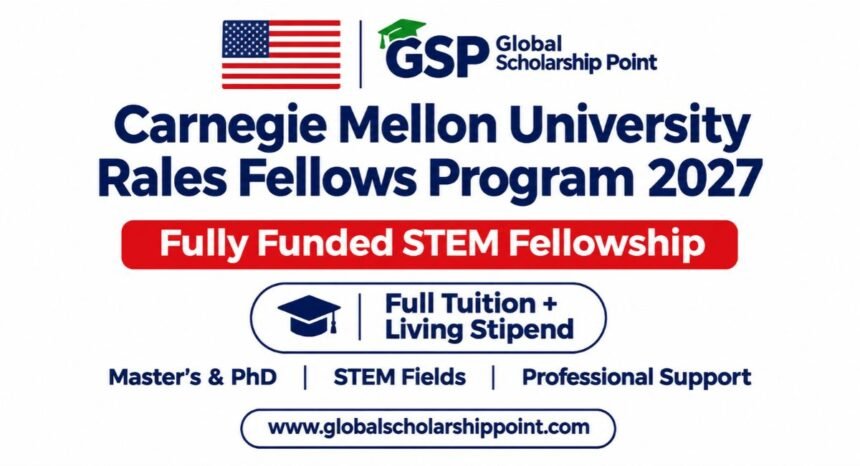
The Carnegie Mellon Rales Fellows Program 2027 offers a fully funded graduate education opportunity for eligible students pursuing science, technology, engineering, and mathematics (STEM) degrees in the United States.
- Carnegie Mellon Rales Fellows Program 2027 Details
- Fellowship Benefits
- Eligibility Criteria
- Available Fields and Programmes
- Required Documents
- How to Apply for Carnegie Mellon Rales Fellows Program 2027
- Application Deadline and Selection Process
- Frequently Asked Questions
- Final Thoughts
- Official Application Links
- Get Scholarship Updates
Hosted by Carnegie Mellon University (CMU) in Pittsburgh, Pennsylvania, the programme supports outstanding students through full tuition funding, living-expense assistance, academic mentoring, professional development, and leadership opportunities.
The fellowship supports eligible master’s and doctoral programmes across several academic departments.
Applications for the 2027 cohort are currently open, with a priority review deadline of December 15, 2026.
Important: This opportunity is restricted to U.S. citizens, permanent residents, and DACA recipients who meet additional eligibility requirements. International students without one of these statuses are not eligible.
The Carnegie Mellon Rales Fellows initiative helps eligible students overcome financial barriers while pursuing advanced STEM education at a leading U.S. research university.
Carnegie Mellon Rales Fellows Program 2027 Details
| Scholarship Details | Information |
|---|---|
| Fellowship Name | CMU Rales Fellows Program |
| Host University | Carnegie Mellon University |
| Country | United States |
| Campus | Pittsburgh, Pennsylvania |
| Degree Levels | Master’s and PhD |
| Academic Fields | STEM |
| Funding | Full tuition and living stipend |
| Master’s Living Stipend | $35,000 |
| Tuition Support | Up to two years |
| Eligible Nationalities/Status | U.S. citizens, permanent residents, DACA recipients |
| Applications Opened | September 1, 2026 |
| Priority Deadline | December 15, 2026 |
| Final Candidacy Deadline | February 1, 2027 |
| Academic Intake | Fall 2027 |
The programme was established through the support of the Norman R. and Ruth Rales Foundation to expand access to graduate STEM education.
It aims to help talented students develop their research abilities, leadership potential, and professional careers without facing the same financial barriers that often accompany advanced education.
The Rales Fellows Program also provides opportunities for interdisciplinary collaboration across Carnegie Mellon’s academic community.
You Can Also Apply For UKRI International Placement Scheme 2027 – Funded Research
Fellowship Benefits
Through Carnegie Mellon Rales Fellows, selected students gain access to financial assistance, mentorship, leadership training, and professional development opportunities.
Financial benefits include:
- Full tuition support for eligible graduate programmes.
- Tuition funding for up to two years.
- A $35,000 living-expense stipend for master’s fellows.
- Living support that can help cover housing, health insurance, and other expenses.
- Department-specific stipend arrangements for PhD fellows.
The $35,000 figure applies to the master’s stipend described in the university’s official FAQ. PhD fellows receive the stipend specified in their departmental admission offers.
Academic and professional benefits include:
- Dedicated faculty mentoring.
- Personalised career coaching.
- Leadership development opportunities.
- Professional networking with academic and industry leaders.
- Access to a supportive interdisciplinary fellowship community.
- Cohort-based onboarding activities.
- A leadership retreat and professional development events.
The programme is designed to support both academic achievement and long-term career development.
Eligibility Criteria
Carnegie Mellon Rales Fellows applicants must satisfy both the university’s graduate admission requirements and the fellowship’s specific eligibility conditions.
Candidates must:
- Be a U.S. citizen, U.S. permanent resident, or DACA recipient.
- Apply to an eligible graduate STEM programme at CMU’s Pittsburgh campus.
- Meet the academic admission requirements of their chosen programme.
- Have received a Federal Pell Grant or need-based financial aid during undergraduate study, or be a first-generation college student.
- Demonstrate alignment with the programme’s goals and attributes.
- Submit both the graduate programme application and the separate Rales Fellows candidacy application.
The programme places particular emphasis on students who have demonstrated academic promise, leadership potential, determination, innovation, and commitment to advancing STEM.
Can international students apply?
Students applying from outside the United States are not automatically eligible.
The fellowship requires U.S. citizenship, permanent residency, or DACA status. An international student who does not hold one of these statuses cannot qualify solely through admission to Carnegie Mellon University.
This distinction is particularly important for international applicants searching for fully funded U.S. scholarships.
Available Fields and Programmes
More than 120 graduate STEM programmes are eligible for consideration, including master’s and doctoral degrees.
Participating academic areas include:
- Computer Science
- Artificial Intelligence and Machine Learning
- Robotics
- Electrical and Computer Engineering
- Mechanical Engineering
- Civil and Environmental Engineering
- Chemical Engineering
- Biomedical Engineering
- Biological Sciences
- Computational Biology
- Chemistry
- Physics
- Mathematical Sciences
- Statistics and Data Science
- Neuroscience
- Human-Computer Interaction
- Materials Science and Engineering
- Engineering and Public Policy
Eligible programmes are offered through Carnegie Mellon’s College of Engineering, Mellon College of Science, Dietrich College of Humanities and Social Sciences, and School of Computer Science.
Not every graduate degree at Carnegie Mellon qualifies.
Only eligible Pittsburgh-based academic programmes are covered. Online, bicoastal, and other excluded campus arrangements do not qualify.
Applicants should consult the official programme eligibility information before submitting their applications.
Check Tarbell Fellowship 2027–28 – Prestigious Paid Programme
Required Documents
The fellowship requires a separate candidacy application in addition to the university’s graduate admission application.
Applicants should prepare:
- Completed Rales Fellows candidacy application.
- Application to an eligible CMU graduate programme.
- Academic transcripts and qualifications required for graduate admission.
- Current resume or curriculum vitae.
- Short essays addressing the fellowship’s attributes and goals.
- One recommendation letter highlighting leadership qualities.
- Any additional documents required by the selected academic department.
Application essays
The fellowship asks candidates to explain how their experiences, aspirations, and values align with the Rales Fellows attributes.
Applicants should discuss meaningful examples of leadership, creativity, collaboration, perseverance, or contributions to their communities.
Strong essays should provide specific evidence rather than relying on general claims.
Recommendation letter
Applicants should choose someone who can discuss their leadership potential, personal strengths, and commitment to their goals.
Graduate programmes may have separate recommendation-letter requirements, so applicants should carefully distinguish between the two applications.
How to Apply for Carnegie Mellon Rales Fellows Program 2027
The application process involves two separate submissions.
Step 1: Choose an eligible graduate programme
Visit Carnegie Mellon University’s official website and identify a qualifying master’s or doctoral STEM programme on the Pittsburgh campus.
Step 2: Check programme admission requirements
Review the degree qualifications, application deadlines, required tests, and supporting documents for your chosen academic programme.
Step 3: Submit the graduate admission application
Apply directly to the eligible CMU graduate programme.
Step 4: Open the Rales Fellows application
Visit the official Rales Fellows admission page and access the separate candidacy application.
Step 5: Prepare your fellowship materials
Complete the required essays, obtain the recommendation letter, and provide any additional requested information.
Step 6: Submit before the deadline
Submit your Rales Fellows candidacy application by December 15, 2026, for priority review.
Step 7: Monitor your application
Applicants who progress through the selection process may be invited to participate in an interview.
Step 8: Complete the selection process
Candidates must secure admission to an eligible CMU graduate programme to advance toward fellowship selection.
Submitting the fellowship application does not guarantee admission or funding.
Application Deadline and Selection Process
The Carnegie Mellon Rales Fellows Program 2027 has two important candidacy deadlines:
- December 15, 2026: Priority review deadline for master’s and PhD candidates.
- February 1, 2027: Final Rales Fellows candidacy application deadline.
Individual graduate programmes may have earlier or different admission deadlines.
Applicants must meet both their academic programme’s requirements and the Rales Fellows candidacy requirements.
Selection timeline
The university identifies semifinalists and finalists during the spring selection period, generally between March and April.
Semifinalists participate in a Zoom interview with programme staff.
Finalists are considered for fellowship selection based on academic admission, their application materials, and alignment with programme goals.
The official timeline also lists April 15 as the intent-to-enroll deadline.
Applicants should review the current university schedule regularly for any updates.
Frequently Asked Questions
1. Is the Carnegie Mellon Rales Fellows Program fully funded?
Yes. The programme provides full tuition support and a living stipend for selected fellows. Funding details differ between master’s and doctoral students.
2. How much is the master’s stipend?
Carnegie Mellon states that master’s fellows receive a $35,000 stipend to help cover living expenses.
3. Can Pakistani, Indian, or other international students apply?
Only if they hold an eligible U.S. immigration status—U.S. citizenship, permanent residency, or DACA—and meet the remaining criteria. International applicants without one of these statuses are not eligible.
4. Are PhD students eligible?
Yes. The programme supports eligible master’s and doctoral STEM programmes.
5. Is a separate fellowship application required?
Yes. Candidates must apply to an eligible Carnegie Mellon graduate programme and separately submit the Rales Fellows candidacy application.
6. What is the deadline for the 2027 intake?
The priority review deadline is December 15, 2026, and the final fellowship candidacy deadline is February 1, 2027. Academic programme deadlines may differ.
Final Thoughts
The Carnegie Mellon Rales Fellows Program 2027 is a valuable fully funded opportunity for eligible U.S.-based students pursuing advanced STEM education.
With full tuition funding, living-expense assistance, faculty mentoring, and professional development support, the fellowship can help students pursue graduate education at Carnegie Mellon University.
However, the programme has strict eligibility requirements, including U.S. citizenship, permanent residency, or DACA status and qualifying educational or financial circumstances.
Applicants should review these requirements carefully and submit both applications before their respective deadlines.
For students who meet the eligibility requirements, Carnegie Mellon Rales Fellows offers a pathway to graduate STEM education with substantial financial and academic support.
For additional funding opportunities, explore the Knight-Hennessy Scholars Program and Purdue University SURF Program on Global Scholarship Point.
Official Application Links
Get Scholarship Updates
Stay connected with Global Scholarship Point for scholarships, fellowships, internships, and international education opportunities.
Author: Muhammad Khayam Afridi — Founder & Editor
Last verified: November 7, 2026