

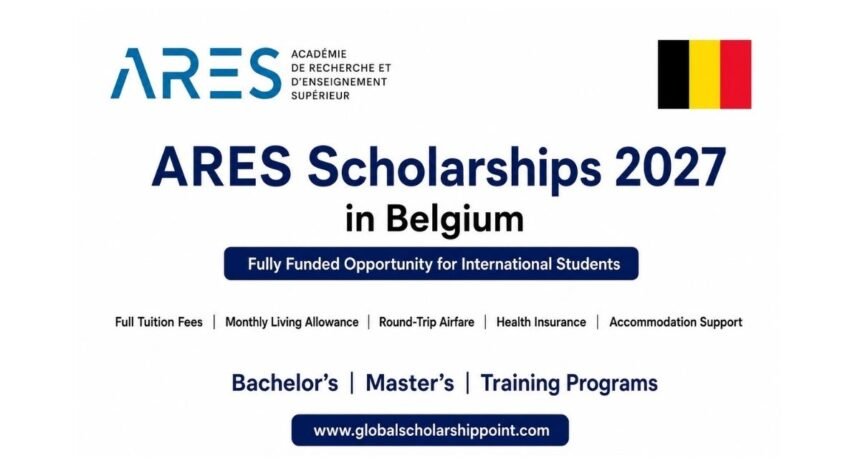
The ARES Scholarships 2027 support selected professionals from partner countries who want to take a specialized course of study in French-speaking Belgium. The official name for this opportunity is the ARES International Training Scholarships 2027–2028.
- ARES Scholarships 2027 Details
- Benefits of ARES Scholarships 2027
- Eligibility for ARES Scholarships 2027
- Required Documents
- Step-by-Step Application Process
- ARES Scholarships 2027 Deadline
- Frequently Asked Questions
- Can I apply for any Belgian university degree with ARES Scholarships 2027?
- What kinds of courses are supported?
- Is the scholarship available to applicants from every country?
- Are travel and living expenses covered?
- Is the GIRAF account deadline the same as the scholarship deadline?
- Can I edit my application after submitting it?
- Apply Now and Official Website
These awards are linked to specific training programs. Depending on the course, a participant may pursue a specialized bachelor’s degree, a specialized master’s degree, or a shorter continuing education program. Choosing a course that fits your previous education and work is an important part of assessing the opportunity.
If you are reading about ARES for the first time, picture the application from the selection committee’s side. They need to understand the work you have already done, the problem you want to address, and why this particular training will help. A clear account of a real project will do more for that explanation than a long list of ambitious claims.
ARES Scholarships 2027 Details
| Detail | Information |
|---|---|
| Official program | ARES International Training Scholarships 2027–2028 |
| Organizer | Académie de recherche et d’enseignement supérieur (ARES) |
| Host country | Belgium |
| Location of study | Higher education institutions in the Wallonia-Brussels Federation |
| Training types | Selected specialized bachelor’s, specialized master’s, and continuing education programs |
| Intended applicants | Eligible professionals from ARES partner countries |
| Application route | ARES GIRAF platform |
| Applications opened | August 3, 2026 |
| Deadline for requesting a new GIRAF account | September 4, 2026 |
| Final application deadline | September 18, 2026, at 12:00 noon Belgian time |
| Application status | Currently closed |
ARES funding applies to the training programs named in its call, rather than every bachelor’s or master’s degree offered in Belgium. Read the individual course description before drawing up your application plan.
Benefits of ARES Scholarships 2027
The ARES Scholarships 2027 provide financial support intended to help selected participants travel to Belgium and complete their approved training. The exact support depends on the type of program and the official award terms.
For the 2027–28 call, ARES lists support that includes international travel expenses and a subsistence allowance. Certain exceptional costs associated with a visa application may be covered for eligible specialized bachelor’s and master’s participants. Other scholarship costs and arrangements are described in ARES’s official call, so applicants should read the terms for their selected training rather than assuming every expense is paid in the same way.
This distinction matters when making a budget. “Fully funded” is a useful description of the broad support available, but a recipient should still check when payments are made, which expenses must be paid first, and what documentation is needed for reimbursement. Flights, a visa appointment, and the first weeks after arrival do not necessarily create costs on the same day.
The academic benefit is also specific. ARES’s international training scheme offers advanced degree programs of approximately one academic year, as well as more practical continuing education programs generally lasting two to six months. A short certificate and a specialized master’s degree serve different goals; neither should be described as an ordinary undergraduate degree.
Think about what you want to bring home from the training. If you work in public health, for example, the useful outcome might be a method you can apply in a local health system. If you work in development finance, it might be a better way to evaluate a program. The value of the award depends partly on how well the training matches your work.
For another European opportunity aimed at professionals, read our Swedish Institute Scholarships 2027 guide. Its eligibility, study programs, and application steps are different from ARES’s.
Eligibility for ARES Scholarships 2027
ARES’s 2027–28 call is intended for applicants from its designated partner countries. Applicants must check the official country list and the requirements for their chosen course. A country being eligible for one international scholarship does not mean it is automatically eligible for ARES.
The call focuses on people who can connect further training to their professional experience. Key checks include:
- Your nationality and residence meet the conditions in the ARES call.
- You meet the academic entry requirements for the particular training program.
- You have the relevant professional background required by the call and your chosen program.
- You can explain how the training relates to work you have done and what you hope to do afterward.
- You can provide the evidence requested in the official application.
The course-level rules deserve as much attention as the general scholarship rules. A specialized master’s degree may require a particular earlier qualification, while a short professional course may look for different experience. Read both the ARES eligibility information and the program description.
If you are deciding whether your experience is relevant, start by writing down a problem you have worked on firsthand. What was your role? Who benefited from your work? What knowledge was missing? Those questions can help you choose a training program and describe your reasons for applying without sounding generic.
You should also check the language of instruction for the selected program. Belgium’s Wallonia-Brussels Federation offers courses in different languages; an applicant needs to meet the language requirements of the actual course they choose.
Our DAAD Scholarships 2027 guide is another route to explore if your academic plans include Europe. DAAD manages multiple German funding programs, so its eligibility is separate from ARES’s.
Required Documents
The ARES Scholarships 2027 application was handled through ARES’s GIRAF platform. Document requirements can depend on the training selected and the fields shown in the official form. Applicants should use the 2027–28 candidate guide and call document for the definitive checklist.
Materials to prepare or check may include:
- Proof of identity and the personal details requested in GIRAF
- Academic diplomas and transcripts relevant to the course
- A current CV showing education and professional history
- Evidence of relevant employment or professional activity
- Responses explaining your motivation and the link between training and your work
- Any language evidence or course-specific material requested
- Additional supporting files required by the official application
Do not assume a recommendation letter, passport scan, or particular certificate is mandatory for every ARES course simply because another scholarship asks for one. Look at the fields and instructions for your selected training before uploading documents.
The most useful preparation is to make your CV and explanation agree. If the application describes a project as your main achievement, your CV should give the reader enough context to place that project in your professional history. Dates, roles, and results should be consistent across the file.
For scanned documents, check that every page is readable and that names and dates are visible. A clear application is easier to assess than one that requires a reviewer to guess what an attachment says.
Step-by-Step Application Process
The following steps describe how applicants approached the ARES Scholarships 2027 call. They are useful for understanding the process and preparing for a future ARES announcement; the 2027–28 submission period has passed.
Step 1: Read the official ARES call. Start with the 2027–28 international training page and candidate guide. Check the eligible partner countries and general conditions.
Step 2: Choose one suitable training program. Read its course description, duration, language, entry requirements, and professional focus. Choose a program for a reason you can explain through your previous work.
Step 3: Check access to GIRAF. Applicants needed a GIRAF account created and validated by ARES. For this cycle, the deadline to request creation or validation of a new account came before the final application deadline.
Step 4: Gather your evidence. Prepare your academic records, professional history, and course-specific attachments. Use the official guide to determine the required files and formats.
Step 5: Complete the GIRAF form. Log in, find the international training call, and enter the requested information. Save and review each section carefully.
Step 6: Explain the connection to your work. Use a concrete example: describe a challenge you faced, what you tried, and what you expect to learn from the chosen training. Give the reviewer a reason to see this particular course as the next step.
Step 7: Review before submitting. Check your personal details, eligibility answers, dates, and attachments. ARES’s instructions say submitted applications cannot be modified, making this last review particularly important.
Step 8: Submit through the official platform. For any future cycle, follow the deadline and platform instructions published for that cycle. Save the confirmation and watch for messages from ARES.
If you are also considering a multi-university master’s program in Europe, our MAPP Erasmus Mundus Scholarship 2027 guide explains a separate application route.
ARES Scholarships 2027 Deadline
The ARES Scholarships 2027 call for the 2027–28 academic year opened on August 3, 2026. Applicants who needed a new GIRAF account had an earlier deadline of September 4, 2026 to request its creation or validation.
The final application deadline was September 18, 2026, at 12:00 noon Belgian time. The earlier account date was important: waiting until the final application day to request a new account would not have followed the published process.
These dates belong to the 2027–28 call. They should not be reused as dates for a future intake. When ARES publishes another call, check its new course list, country rules, account deadline, and submission deadline together.
A practical note for future applicants: make two reminders, not one. The first is for account access and collecting documents; the second is for final submission. This gives you time to deal with a missing file or account issue while the application window is still open.
Frequently Asked Questions
Can I apply for any Belgian university degree with ARES Scholarships 2027?
No. The scholarship is for the specific international training programs included in the ARES call. Check the official course list before planning an application.
What kinds of courses are supported?
The international training scheme includes selected specialized bachelor’s and master’s degrees and shorter continuing education programs. Course length and admission conditions differ.
Is the scholarship available to applicants from every country?
No. ARES uses a list of partner countries and additional eligibility rules. Always check the list for the relevant call.
Are travel and living expenses covered?
The 2027–28 call includes international travel expenses and a subsistence allowance. Other support depends on the official terms and type of training.
Is the GIRAF account deadline the same as the scholarship deadline?
No. For the 2027–28 call, requests for a new or validated GIRAF account were due September 4, 2026; final applications were due September 18, 2026.
Can I edit my application after submitting it?
ARES’s application instructions say a submitted GIRAF application cannot be modified. Review the complete form and attachments before submission.
Apply Now and Official Website
The ARES Scholarships 2027 offered a focused route for professionals seeking training they could apply in their work. If the program interests you, keep the official ARES page bookmarked and use the next published call—not an older article—to check your country, your preferred course, and the new dates.
You can also compare our Chevening Scholarships 2027 guide for a separate master’s opportunity in the United Kingdom.