


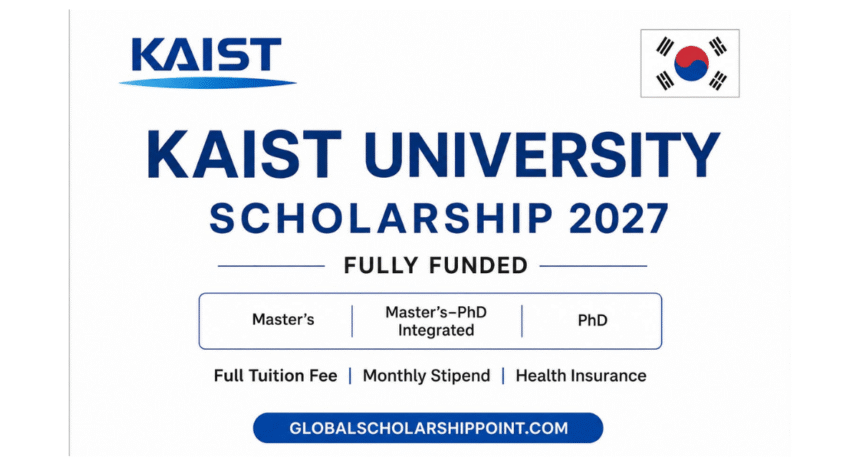
The KAIST University Scholarship 2027 gives eligible international graduate students a route to study in South Korea with full tuition coverage, national health insurance and a monthly stipend. KAIST offers master’s, integrated master’s–PhD and PhD programmes across science, engineering, technology and related fields.
- KAIST University Scholarship 2027 Details
- What Is the KAIST University Scholarship 2027?
- KAIST University Scholarship 2027 Benefits
- Standard KAIST Scholarship
- KAIST Global Presidential Scholarship
- KAIST Prestige Scholarship for International PhD Students
- KAIST University Scholarship 2027 Eligibility
- Available Graduate Study Areas
- Required Documents for KAIST University Scholarship 2027
- How to Apply: Step-by-Step Process
- Step 1: Choose your degree and programme
- Step 2: Read the current admission guide
- Step 3: Prepare evidence of your academic fit
- Step 4: Arrange your language evidence and recommendations
- Step 5: Complete the official online application
- Step 6: Submit and monitor your application
- Step 7: Review your admission and funding offer
- KAIST University Scholarship 2027 Deadline
- Frequently Asked Questions
- 1. Is the KAIST University Scholarship 2027 fully funded?
- 2. Is a separate KAIST Scholarship application required?
- 3. Can international students apply for master’s and PhD study?
- 4. Has the Fall 2027 graduate deadline been announced?
- 5. Will every student receive the KRW 1,000,000 monthly stipend?
- 6. Does this article cover KAIST undergraduate admission?
- Apply Now and Official Website
- Final Thoughts
There is an important timing update for anyone reading this in September 2026: the Spring 2027 international graduate application period has closed. KAIST lists the Fall 2027 graduate application dates as to be announced. If you want to apply for Fall 2027, this is the time to choose a programme and prepare your documents—not to guess a deadline from an older scholarship post.
I would start with the department rather than the scholarship amount. A strong research fit gives you something specific to explain in your application, and the financial package can differ by programme and scholarship type.
KAIST University Scholarship 2027 Details
| Information | Details |
|---|---|
| Host institution | Korea Advanced Institute of Science and Technology (KAIST) |
| Country | South Korea |
| Opportunity | KAIST Scholarship for international graduate applicants |
| Degree levels | Master’s, integrated master’s–PhD and PhD |
| Main benefits | Full tuition, national health insurance and a monthly stipend dependent on research involvement |
| Eligible applicants | Candidates who meet KAIST’s international graduate admission requirements |
| Application route | KAIST international graduate admission application |
| Scholarship selection | Choose “KAIST Scholarship” as the financial resource in the application |
| Spring 2027 application | 18 August–1 September 2026; closed |
| Fall 2027 application | Dates not yet announced on KAIST’s graduate timeline |
| Additional awards | Eligible applicants may be considered for the KAIST Global Presidential Scholarship or KAIST Prestige Scholarship |
What Is the KAIST University Scholarship 2027?
KAIST is a research-focused university in Daejeon. Its international graduate admissions system brings together study programmes and several funding options. For the standard KAIST Scholarship, an applicant selects KAIST Scholarship as the financial resource when completing the graduate admission application.
That selection matters. It tells KAIST that you want to be considered for its scholarship support. Eligible applicants may also be considered for certain additional KAIST awards according to their degree programme and academic profile.
The KAIST University Scholarship 2027 is especially relevant to students who want to develop a research career or apply technical knowledge to a practical problem. Before writing your study plan, look at the work of the department you hope to join. You should be able to explain why that programme fits your previous work in a few clear sentences.
If you are comparing research universities in South Korea, our GIST Scholarship 2027 guide covers a separate graduate opportunity with its own funding rules and deadlines.
KAIST University Scholarship 2027 Benefits
Standard KAIST Scholarship
KAIST says its scholarship for international graduate students provides full tuition coverage, national health insurance and a monthly stipend. The stipend depends on research involvement, and its amount can vary by college or department. KAIST states that this scholarship benefits a large share of its international students, but applicants should still read the funding terms of their individual offer.
Full tuition coverage is a major benefit. It does not mean every possible expense—such as travel, housing or personal spending—is automatically paid. Build a living-cost budget before accepting an offer, then compare that budget with the stipend stated in your admission and funding documents.
KAIST lists the standard scholarship across its graduate departments except the Global Technology Innovation Program’s GDI-GTIP track. Check your chosen programme’s current admission guide rather than assuming every track uses the same funding arrangement.
KAIST Global Presidential Scholarship
Master’s and integrated master’s–PhD applicants who choose the KAIST Scholarship may be considered for the KAIST Global Presidential Scholarship (KGPS). KAIST lists full tuition and a stipend of KRW 1,000,000 per month for four regular semesters for selected recipients.
KAIST says no separate KGPS application is required through this route. Selection is competitive, with recommendations made through the department. Treat this as a possible additional award, not as the stipend promised to every applicant.
KAIST Prestige Scholarship for International PhD Students
KAIST also lists the KAIST Prestige Scholarship (KPS) for eligible PhD and integrated master’s–PhD applicants. Its published benefits are full tuition and KRW 300,000 per month for eight regular semesters for selected recipients. For an integrated-program student, this particular award begins at the PhD stage.
The figure above describes KPS; it should not be mistaken for the standard KAIST Scholarship stipend. Confirm the precise amount and conditions in any funding offer you receive.
For another South Korean graduate option, read our UST Scholarships 2027 article. UST’s research institute model may suit a different kind of project.
KAIST University Scholarship 2027 Eligibility
To apply through international graduate admissions, you must meet KAIST’s citizenship rules. Its eligibility page says applicants must be citizens of countries other than Korea; people holding Korean citizenship cannot use this international graduate route. Applicants of Korean descent who hold foreign citizenship should read KAIST’s additional documentation and education-history rules carefully.
Your previous degree must also match the level you want to enter:
- Master’s or integrated master’s–PhD: a bachelor’s degree or recognised equivalent by the start of the course.
- PhD: a master’s degree or recognised equivalent by the start of the course.
KAIST’s international graduate admissions page also sets English-language requirements and lists circumstances in which an exemption can be requested. Check the current accepted tests, score rules and exemption evidence for your admission round. A degree taught in English does not automatically mean every applicant is exempt; the university’s stated conditions decide that.
Finally, check your specific department. A promising applicant can still choose a poor match if the programme does not admit international students in the intended round or does not support the research area they describe. KAIST directs applicants to the current application guide for the confirmed list of participating programmes.
Available Graduate Study Areas
Depending on the admission round, KAIST’s graduate programmes cover areas such as computing, artificial intelligence, engineering, materials, natural sciences, life sciences, design and interdisciplinary research. The available departments and their requirements can change between rounds.
A useful preparation exercise is to write down three things: the problem you want to study, the work you have already done on it and the KAIST programme where you could develop that work. This will give your statement of purpose a clearer centre than a paragraph about rankings.
The KAIST University Scholarship 2027 may also attract applicants who are deciding between university funding and a government route. These are different applications. Our GKS Scholarship 2027 guide discusses the undergraduate government scholarship; use KAIST’s official graduate pages for the graduate route described here.
Required Documents for KAIST University Scholarship 2027
The final document checklist comes from the application guide for your chosen intake. Prepare for materials such as:
- Completed online graduate application
- Passport and any required nationality evidence
- Degree certificate or expected-graduation evidence
- Academic transcripts
- English proficiency result or approved exemption evidence
- Recommendations submitted according to KAIST’s instructions
- Statement of purpose or study information requested in the application
- Additional research, portfolio or department-specific materials, if required
Your documents may need translation or later verification. Start early if your university takes time to issue official transcripts or certificates. Check that names and dates match across your passport, academic records and online form.
For recommendations, choose someone who has seen your work closely. A detailed letter explaining a project you completed is more useful than a vague endorsement from someone with a senior title. Give your recommender the programme name, deadline and enough time to submit through the required system.
Do not use a checklist from a previous year as your final authority. Open the latest KAIST guide once Fall 2027 dates are published and check every item again.
How to Apply: Step-by-Step Process
Step 1: Choose your degree and programme
Decide whether you are applying for a master’s, integrated master’s–PhD or PhD. Review KAIST’s graduate programme list and check that your target department is accepting international applicants in your chosen admission round.
Step 2: Read the current admission guide
The guide for that round should be your working checklist. Confirm eligibility, programme availability, application dates, document format, recommendation process, fee rules and any departmental requirements. Fall 2027 graduate dates are still to be announced, so check KAIST’s official timeline for updates.
Step 3: Prepare evidence of your academic fit
Gather transcripts and degree evidence. Then draft a statement that connects your past study or research with the programme you chose. Give specific examples: a thesis question, a laboratory method, a software project or a problem you tried to solve at work.
For the KAIST University Scholarship 2027, showing a thoughtful academic match is more helpful than repeatedly describing KAIST as a prestigious university.
Step 4: Arrange your language evidence and recommendations
Check whether you need an accepted English test or qualify for an exemption under KAIST’s published rules. Contact recommenders before the application window becomes busy, and tell them how KAIST expects their letters to be submitted.
Step 5: Complete the official online application
When the relevant Fall 2027 portal opens, enter your details carefully and choose KAIST Scholarship as your financial resource if you want to request this funding. Review the degree, department and scholarship selection before submission.
Step 6: Submit and monitor your application
Submit all required information by the official deadline for your round. Keep an eye on your application account and email for requests from KAIST. If the department asks for further information or an interview, follow the instructions it sends you.
Step 7: Review your admission and funding offer
If admitted, read the scholarship terms closely. Confirm the tuition coverage, stipend, insurance arrangements and any conditions attached to the award. That is the point to finish a realistic budget for studying in Daejeon.
KAIST University Scholarship 2027 Deadline
KAIST’s official international graduate timeline lists 18 August to 1 September 2026 for Spring 2027 entry. That application period has passed.
For Fall 2027 entry, the same KAIST timeline currently says “TBA”. KAIST describes its usual Fall Early and Fall Regular application periods, but those general patterns are not confirmed Fall 2027 deadlines. Return to the official timeline and application guide for announced dates before publishing a deadline or submitting an application.
Also be careful when searching: KAIST’s undergraduate 2027 deadlines are published on a different admissions page. They do not apply to the graduate scholarship route in this article.
Frequently Asked Questions
1. Is the KAIST University Scholarship 2027 fully funded?
The standard graduate scholarship covers full tuition and provides national health insurance and a monthly stipend. The stipend varies, so applicants should check their individual offer and budget for costs that the scholarship terms do not explicitly cover.
2. Is a separate KAIST Scholarship application required?
For the standard graduate route, KAIST tells applicants to select KAIST Scholarship as their financial resource in the admission application. Eligible applicants who make that selection may also be considered for specified additional KAIST awards.
3. Can international students apply for master’s and PhD study?
Yes, if they satisfy KAIST’s international graduate citizenship, degree, language and programme requirements. Master’s and integrated-program applicants generally need a bachelor’s degree; PhD applicants generally need a master’s degree.
4. Has the Fall 2027 graduate deadline been announced?
No. KAIST’s published graduate timeline lists Fall 2027 entry as TBA. The Spring 2027 application period closed on 1 September 2026.
5. Will every student receive the KRW 1,000,000 monthly stipend?
No. That figure belongs to the competitive KAIST Global Presidential Scholarship for selected eligible students. The standard KAIST Scholarship stipend depends on factors including research involvement and can differ by college.
6. Does this article cover KAIST undergraduate admission?
No. This KAIST University Scholarship 2027 guide focuses on international graduate admissions. KAIST publishes undergraduate admissions, scholarship information and deadlines separately.
Apply Now and Official Website
Final Thoughts
The KAIST University Scholarship 2027 is a strong option for an international student whose research interests match a KAIST graduate programme. Full tuition coverage, health insurance and stipend support can remove a significant part of the financial pressure of graduate study.
The next practical step is to prepare for a Fall 2027 application while KAIST finalises its dates. Choose a suitable department, collect your documents and write about work you have actually done. Once the official guide appears, use it to verify your eligibility, funding selection and deadline before you submit.